
How to Check Criminal History in Williamsburg County
Begin with the Williamsburg Public Index when the goal is to understand a filed court case. It is the free county view of General Sessions events and dispositions. A very new arrest may not be there yet. In that case, call the Williamsburg County Detention Center and the arresting police department first. Use the local court for a town-level charge. Add a SLED CATCH report when you need South Carolina repository data tied to fingerprint submissions.
Good searches use a full name, date of birth, known spelling variants, an approximate event date, and a case or booking number when one is available. Never treat a same-name result as identity proof. Keep the court case number and agency report number separate because each identifies a different record. The clearest order is:
- Search the Williamsburg Public Index by exact case number or a carefully entered party name.
- Call the detention center for a recent booking that has not reached the court index.
- Ask the arresting agency for its incident or arrest report through the documented records channel.
- Order a SLED CATCH report for the fingerprint-supported South Carolina history layer.
- Request the filed order or a certified copy from the court clerk when a screen result is not enough.
The official Williamsburg Public Index source also supplied this view of the county search entry point.
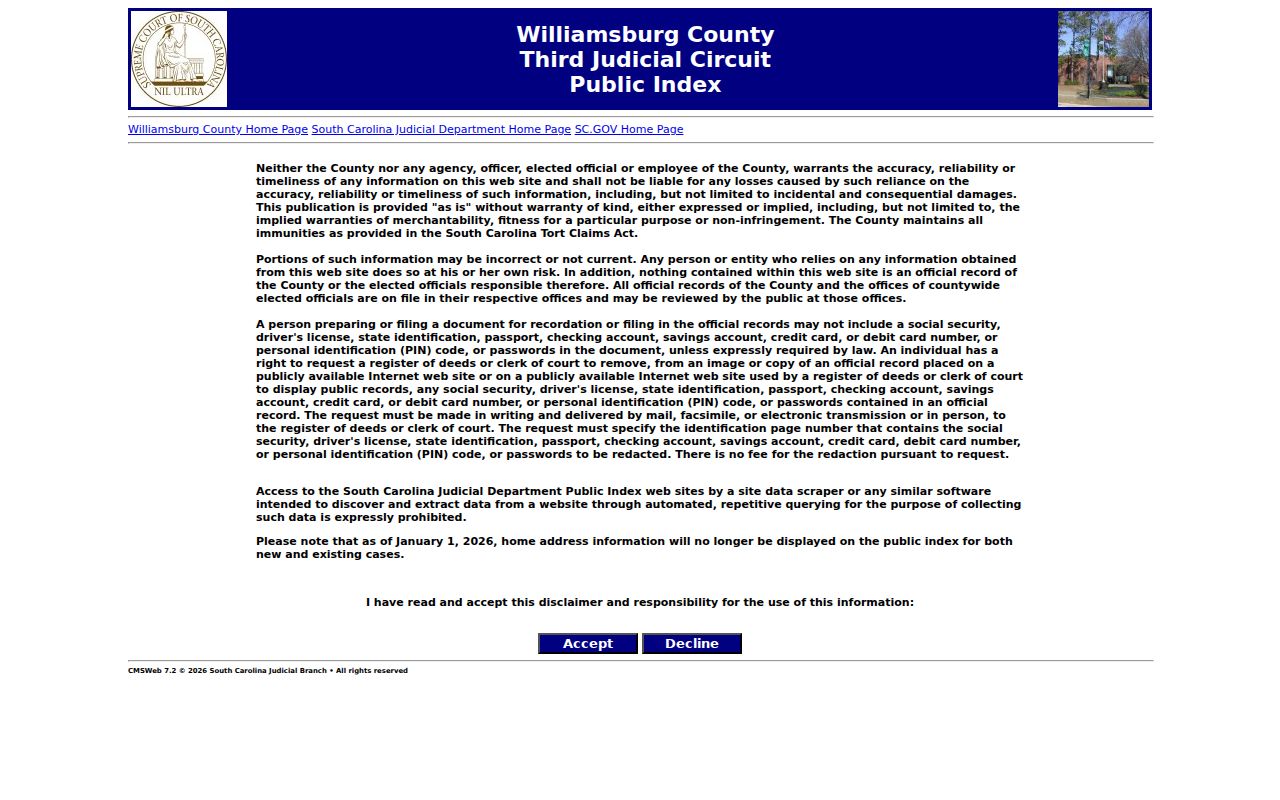
The screen is a route into a docket, not a fingerprint-authenticated identity report or a promise that every document image is online.
Four Williamsburg County Criminal Record Custodians
One event can create several records. The arresting sheriff or police department writes the incident and arrest reports. The detention center records booking, custody, bond, release, and transfer events. The Clerk of Court keeps the later General Sessions file. SLED assembles the statewide criminal-history cycle from fingerprints and disposition reports. Asking one office for all four products often leads to a delay because no single county counter owns the whole trail.
Use the desired fact to choose the first channel. This local split also explains why two official results can look different without either being false.
| Needed fact | First custodian | Best channel |
|---|---|---|
| Officer narrative or incident detail | Arresting agency | Agency records request |
| Booking, bond, or current county custody | Detention Center | Phone, counter, or focused FOIA request |
| Filed charge, docket, or disposition | Clerk or summary court | Public Index, clerk call, or copy request |
| State criminal-history cycle | SLED CJIS | CATCH name check |
Official South Carolina Background Checks
The South Carolina Law Enforcement Division, Criminal Justice Information Services unit keeps the state Computerized Criminal History repository. Its public product, SLED CATCH, is a name-based South Carolina check supported by fingerprint submissions from arresting agencies. It is not the police narrative, a full court file, an FBI history, or a sex offender registry search. Spelling, aliases, birth-date errors, and delayed submissions can affect a result.
A standard CATCH report costs $25 and is nonrefundable. Since July 1, 2026, an online $25 report also carries a stated $1.43 service fee. Mail requests use the official form, accepted payment, and a self-addressed stamped envelope. Cash and personal checks are not accepted. Ask for certified or notarized output when that form is required. For personal federal history, the subject uses the FBI fingerprint-based Identity History Summary process rather than a county name search.
SLED directs fingerprint procedures by the program that requires them. No general-public IdentoGO enrollment center was verified inside Williamsburg County. Call the Sheriff or Kingstree Police to ask whether civil fingerprint cards are offered, whether an appointment is needed, and what identification, cards, and fee apply. A person reviewing a federal record can use the official FBI electronic request channel, mail a fingerprint card, or select an FBI-approved channeler.
Williamsburg County Criminal Records in CATCH
The SLED CATCH gateway requires acceptance of its terms before the search form opens. Enter identity data with care. A middle name can help separate common names, while a wrong birth date can hide the right cycle or surface the wrong one. The portal does not search the South Carolina Sex Offender Registry, so community-awareness searches require a separate registry visit.
The official gateway image below shows where statewide criminal-history requests begin.
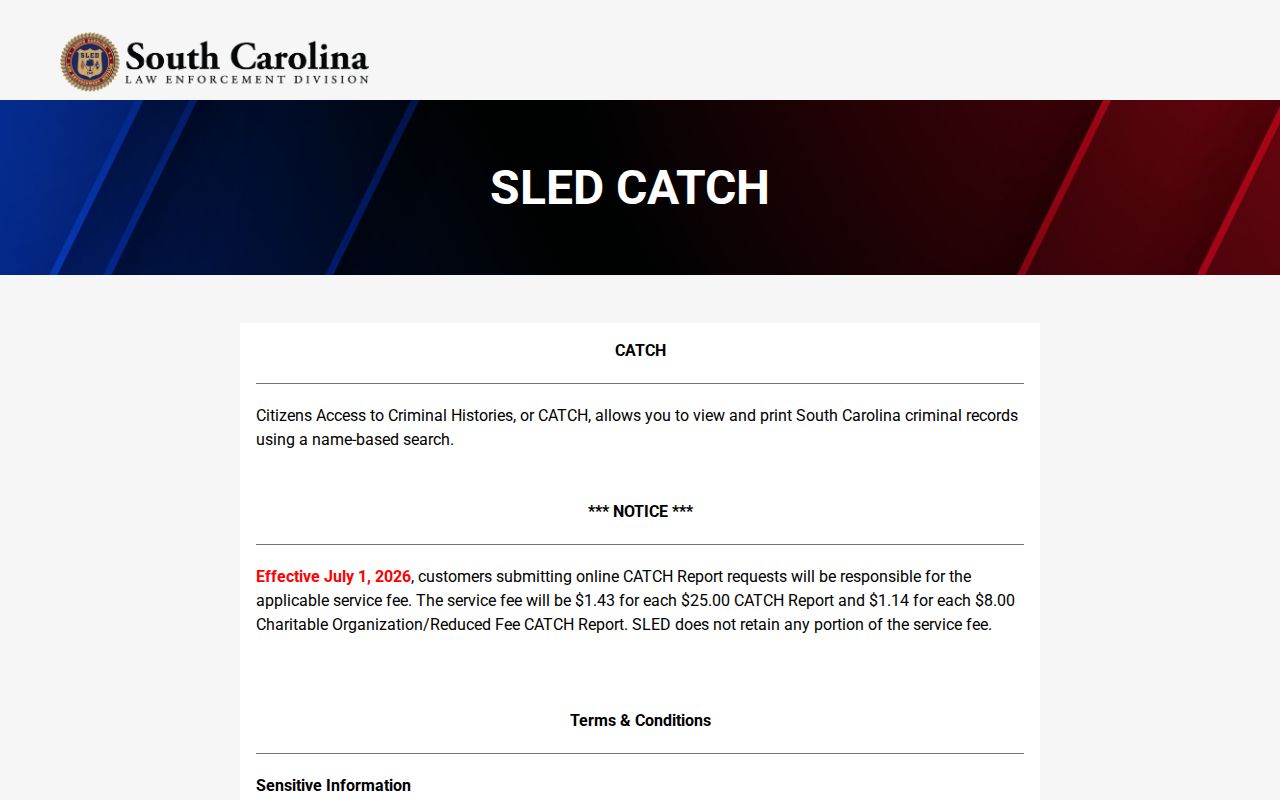
Save the search details and report number, especially when reviewing your own record or asking SLED and the court to correct a mismatch.
| Field | Use | Status |
|---|---|---|
| Terms agreement | Opens the official search | Required |
| First and last name | Core name match | Required |
| Middle name | Narrows possible matches | Optional or unspecified |
| Date of birth | Identity-matching component | Required |
| Social Security number | Use only if the secure official form presents it | Optional |
Types of Criminal Records
Williamsburg County records reflect different steps, not interchangeable labels. A report may exist even when no arrest follows. Booking proves that the jail processed a person, not that a court found guilt. The docket shows what prosecutors filed and how the judge handled it. CATCH combines reported state cycles but does not reproduce the underlying police file. SCDC covers people sentenced to state custody, not those awaiting court in the county jail.
South Carolina does not place every offense in one simple letter grid. S.C. Code Title 16, Chapter 1 supplies general felony and misdemeanor classes, but an offense-specific statute can control the penalty and venue. Felonies and higher-level misdemeanors usually belong in General Sessions. Authorized lower-level matters may stay with a magistrate or municipal court. Read the filed charge and final sentence rather than infer an outcome from a portal label.
These plain terms keep the search focused:
- Incident report
- The investigating agency's account and evidence index, with lawful redactions where needed.
- Booking record
- The detention intake, photographed and fingerprinted identity, booked charges, bond, and custody events.
- Case file
- The court record of filed charges, hearings, motions, plea or trial, sentence, and disposition.
- Bench warrant
- A court order tied to a failure to appear or comply, handled through the issuing court.
- Repository report
- SLED's statewide name-query product based on criminal-history information submitted to the state system.
Williamsburg County Booking Record Timeline
The Williamsburg County Detention Center is a 205-bed facility at 200 S. Jackson Street in Kingstree. Bond Court meets inside the facility at 9 a.m. and 3 p.m. every day, including weekends and holidays. That schedule creates a local judicial record soon after many custodial arrests. A General Sessions entry may arrive later because the solicitor must screen the matter and the clerk must receive the filing.
The official detention center source supplied the facility image and confirms its county role.
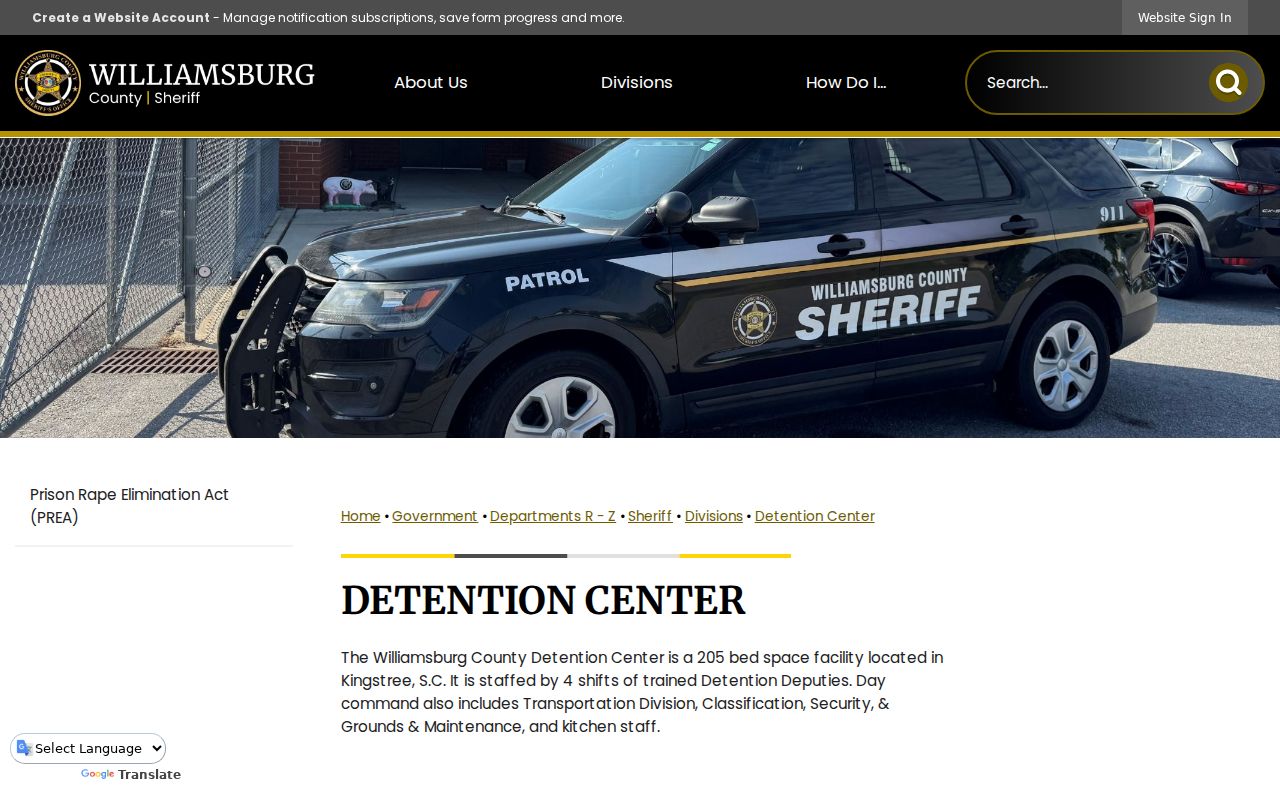
The practical sequence is arrest, booking, bond appearance, solicitor review, court filing, disposition, then reporting to SLED. Each stop may update on a different day.
Record flow: Arresting agency › Williamsburg County booking › Bond Court › Clerk and Solicitor › SLED CJIS.
What a Williamsburg County Criminal Record Shows
A court file and a CATCH report share some facts but organize them differently. The court header can show the case number, court, filing date, status, parties, attorneys, charges, and event history. Bond and financial entries may appear. A repository report connects identity information to an arrest cycle, fingerprint transaction, judicial result, and sentence or custody data when those items were sent to SLED.
Read the source date and status before drawing any conclusion. A pending entry is not a final result, and a scheduled hearing does not prove the event took place.
| Name & Identifiers | Searched name, matched name or alias where released, date of birth, and other lawful identifiers. |
|---|---|
| Arrest / Booking Data | Arrest date, agency, booking number, photographed or fingerprinted intake, and custody events. |
| Charges & Statutes | Alleged offense descriptions and codes, which may change after prosecutor review. |
| Disposition | Pending, conviction, dismissal, acquittal, nolle prosequi, or a missing final report. |
| Sentence | Fine, custody, or supervision terms if entered and publicly releasable. |
| Administrative Data | Case or report number, query date, source office, and limitation notices. |
No Williamsburg County Criminal Booking Roster
No official online Williamsburg County jail roster was found during the August 2026 research. That absence is important. Do not replace the government channel with a mugshot gallery or unofficial people finder. Call the Sheriff or Detention Center at 843-355-6381 and ask for public booking or custody information. A separate county directory lists 843-355-9696 for detention information, so callers should state the purpose and verify the correct line.
If a phone inquiry does not settle the question, ask at the counter, submit a narrow South Carolina FOIA request, check the Public Index after filing time, or use VINELink only after confirming current county coverage inside that service. The SCDC Inmate Search applies after a person is sentenced and transferred to state custody. It reports a prior-midnight snapshot and cannot answer whether someone was just booked in Williamsburg County.
Note: County pages did not publish visitation, phone, money, mail, or vendor rules, so confirm each one before sending funds or traveling.
Public Access Laws
South Carolina FOIA gives the public rights to inspect or copy existing government records, subject to specific exemptions. A public body may redact protected material and release the rest. The law allows reasonable search and copy charges tied to the lowest-paid qualified employee's rate, as well as a deposit of up to 25 percent. For records no more than 24 months old, the agency generally must issue its determination within ten business days. Older records use a twenty-business-day determination period.
Court sealing rules and criminal-record dissemination laws still control their own systems. FOIA does not open a sealed judicial file, juvenile material, victim identifiers, medical data, confidential sources, or investigative details whose release would cause a protected harm.
Key South Carolina laws:
S.C. Code Title 30, Chapter 4 gives access to public records, deadlines, fee rules, and law-enforcement exemptions.
S.C. Code Title 23, Chapter 3 governs fingerprint reporting, SLED criminal-information systems, and registry records.
S.C. Code Section 17-1-40 addresses qualifying arrest-record destruction, sealing, and incident-report treatment.
S.C. Code Title 17, Chapter 22 sets several diversion and expungement routes and the order process.
Williamsburg County Criminal Report Requests
A written request works best when it names an existing record. Give the incident or booking date, location, arresting agency, case number if known, and the exact item, such as an incident report, arrest report, CAD log, photograph, video, or booking sheet. State the desired electronic format and ask for an advance cost estimate. Broad requests for everything increase the need for search, review, and redaction.
Williamsburg Sheriff records begin at 200 S. Jackson Street. Kingstree Police uses an official FOIA form and accepts it at 401 N. Longstreet Street or by email at kpdfoia@kingstree.org. Hemingway and Greeleyville do not publish a verified request form, so call the town first to confirm the custodian, then send a focused written FOIA request. The agency that wrote the report remains the key starting point.
The Williamsburg County government source provides the department directory used to route these local requests.
The directory helps locate an office, but a phone call should still confirm the current counter, hours, and record custodian.
Sealed, Expunged & Restricted
South Carolina uses expungement and an Order for Destruction of Arrest Records. It does not offer one broad civil sealing substitute for ordinary adult files. Juvenile records follow separate rules. Victim and minor identifiers, medical details, Social Security numbers, active techniques, and confidential-source information can also be withheld or redacted even when part of a larger public file.
Williamsburg General Sessions and diversion matters generally begin with the Third Circuit Solicitor at 125 W. Main Street. A dismissed magistrate or municipal charge starts with that summary court. Eligibility depends on the disposition, offense, prior record, waiting period, and program completion, so no result should be promised.
- Identify the court and final disposition from the filed case record.
- Ask the Solicitor or summary court which statute and application route applies.
- Obtain the required agency, prosecutor, and court approvals through that office's process.
- Allow four weeks after SLED receives the signed order, then buy a new CATCH report to verify removal.
Fix Missing Williamsburg County Criminal Dispositions
A missing result should be checked at the source. First open the court file and obtain the filed dismissal, acquittal, sentence, or other final order. Then contact the Clerk and SLED CJIS with the case and report identifiers. A CATCH entry marked pending or missing does not establish the real outcome. It may mean the court's final report has not matched the fingerprint-supported cycle.
When a completed expungement still appears after the stated processing window, SLED instructs the person to mail a certified true copy of the order, a recent CATCH report purchased within 30 days, and a stamped return envelope to its Expungement Department. SLED cannot edit an outside private database. A separate dispute must go to that provider, using the official order as proof.
Criminal Records by City in Williamsburg County
Town police create their own incident and arrest reports, while municipal courts keep the summary cases they hear. The county jail, Bond Court, General Sessions clerk, and SLED add later layers. The three city guides below match the top incorporated places in the 2020 Census baseline used by the research. Each starts at city altitude and then shows when a search must move to Kingstree-based county offices.
Population figures are the cited 2020 counts, not estimates of current residents.
Kingstree Criminal History
3,244 residents · KPD FOIA form and a Thursday Municipal Court channel.
Hemingway Criminal History
459 residents · Phone-first town records and county follow-through.
Greeleyville Criminal History
384 residents · Town custodian confirmation before a written request.
Williamsburg County Criminal Warrant Checks
No public Williamsburg Sheriff warrant database was found. General Sessions assigns pending and indicted cases, expungements, and bench warrants to the clerk reached through 843-355-9321 extension 7102. Kingstree Municipal Court handles its own missed-court warrants. Arrest warrants, bench warrants, and investigative search warrants also have different disclosure limits. An unserved or sealed matter may not appear in a public screen.
To resolve your own possible warrant, confirm the issuing court and sheriff through published numbers. Ask for the case or warrant number, whether bond is preset, and whether an appearance is required. Never send money in response to an unsolicited caller. Obtain the filed recall or disposition after the matter is addressed, then allow time for connected databases to update. CATCH is not advertised as a real-time warrant search.
Williamsburg County Criminal Supervision Records
Probation and parole are state-run in South Carolina. SCDPPPS maintains the Williamsburg County office at 147 W. Main Street in Kingstree. Its July 29, 2026 snapshot listed 133 probation cases, 7 parole cases, 7 community-supervision cases, 2 supervised-reentry cases, and 8 Jessie’s Law tracking cases. Those figures describe active administrative workload, not annual crime or a public name-search database.
Verify a sentence in the court file and use SCDC only for state-custody information. Contact SCDPPPS for releasable supervision records or send its FOIA office a request for existing, nonexempt records. Victim, treatment, safety, and detailed supervision information may be restricted. A violation can lead to a motion, warrant, and revocation hearing, so the issuing court docket remains the sound public route for the filed outcome.
Williamsburg County Criminal Record Geography
Williamsburg County's 2025 Census estimate was 29,662, down from 31,026 counted in 2020. Most major record counters are clustered in Kingstree even though residents live across a broad rural county. The Clerk sits at 201 W. Main Street, the Solicitor at 125 W. Main, and state supervision at 147 W. Main. The Sheriff, jail, and Bond Court are on S. Jackson Street. Kingstree Police and Municipal Court are on N. Longstreet Street.
That compact layout does not merge authority. A police narrative is not held at the Clerk, booking data is not a CATCH report, and a state prison record is not kept by the county jail. Call first if travel is difficult. County pages do not publish a complete parking, security, phone, or accessibility policy for each counter. Ask about hours, identification, archived-file retrieval, copy format, and accommodations before making the trip.